1. Establish the product version before designing the pack
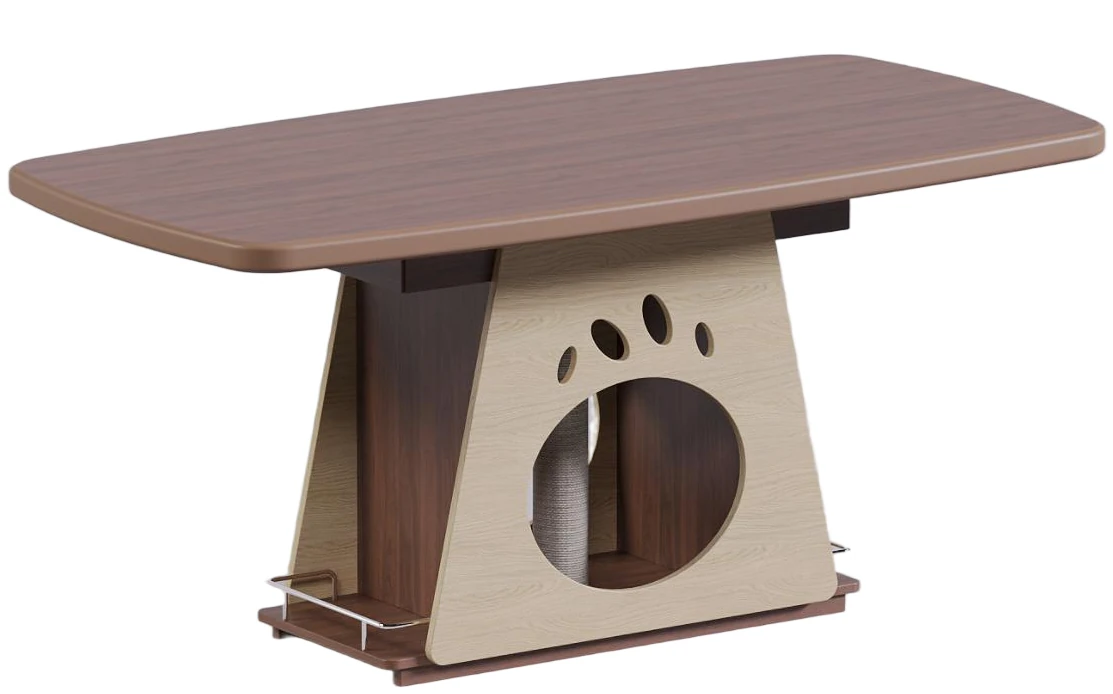
NAV-F074 / M1053 is a dining table with a cat passage integrated into the supporting base. The catalogue exterior is 1600 × 850 × 750 mm. Round openings lead beneath the tabletop; the support has scratching material, and stainless-steel side rails help retain pet bowls or small items. The contrasting oak-and-walnut finish is a colour description, not proof of solid-wood construction.
The board core is unspecified. Ask for the tabletop and base compositions separately, including surface layers and edge treatment. Give the selected version a reference used on the sample file and order. Opening dimensions, chair clearance, loading limits and included contents remain questions; the exterior measurement does not answer them.
2. Build a carton-to-component map
Do not infer the carton count or shipping volume from the assembled table. Request actual packed dimensions, gross and net weights, package count and a contents schedule for the proposed order. If different parts travel separately, give each package a suffix linked to the same product reference. Ask the supplier to identify where the rails, fixings and instruction sheet are placed.
For each carton, record expected components, protection and a photograph reference. Identify any differences between sample and production packing. The receiver should be able to locate the hardware bag without opening unrelated cartons or guessing whether an accessory was included.
- Product reference: NAV-F074 / M1053, finish combination, specification revision and sample identifier.
- Carton reference: package suffix, measured shipping size, actual weight and expected contents.
- Evidence reference: material file, instruction revision, label artwork and the reviewer responsible.
3. Send a connected material file for importer review
Canada’s composite-wood regulations address applicable panels and finished goods, including labelling and records. Because this table’s board core is unspecified, its obligations cannot be determined from the catalogue. Have the importer review the confirmed composition and supply-chain documents against the current consolidated regulations linked below.
Give the reviewer a component index rather than a collection of unnamed attachments. For each document, identify its issuer, covered material, relevant supplier and the table component it supports. Preserve the original alongside any translation. Mark an unclear link as unresolved. A material document for another panel or a freight pallet should not silently become evidence for the proposed tabletop.
4. Separate retail-label review from shipping marks
The Competition Bureau’s prepackaged non-food guidance distinguishes bilingual identity and quantity information from optional text, with exceptions. It also notes additional Quebec requirements. Ask the importer to determine coverage for the proposed consumer package and sales provinces; this does not establish that every transport mark or instruction must be bilingual.
Create separate artwork files for warehouse shipping marks and any consumer-facing package. Have a reviewer check the exact product name, quantity presentation and responsible-business information where applicable. Keep material claims aligned with the approved specification in every language. Decide who approves translations and who checks the printed proof. A translated sentence can still be factually wrong when it describes an unconfirmed board core.
5. Inspect the sample as a receiving rehearsal
Before opening the sample, photograph identifiers and visible carton damage. During unpacking, record each protection layer and the location of components. Count panels, rails and fixings against the map, then assemble using the agreed instruction. Measure the exterior, inspect panel edges and record discrepancies against criteria agreed before dispatch. Do not introduce guessed loading tests or treat appearance as emissions evidence.
Ask a second person to follow the map. Record where the process stalls: an unmarked bag, a drawing with a different rail, or a label missing the version reference. Correct the pack and repeat the affected step before approval.
6. Worked example: a complete table, an incomplete pack
Hypothetical example: a Canadian retailer receives a table sample whose measured exterior and finish meet its agreed sample criteria. All components are present, but the carton contents sheet omits the rail-fixing bag and the proposed retail label names an unconfirmed board material. This describes a planning exercise, not an actual NAVORIQ shipment or test.
The buyer accepts the recorded appearance observations while holding document approval. The supplier corrects the contents map; the importer reviews material evidence and label coverage before artwork is released. Revised files receive a new reference, and the next packing proof is compared with them. Physical completeness and document consistency are separate decisions, so neither an attractive sample nor corrected wording closes the remaining material question.
7. Release a pack that the receiving team can reuse
List the approved specification, packing map, instruction, evidence and artwork revisions on a release page. Assign owners to open items. Review changes to panel sources, finishes, fixings, carton counts or language files before reordering. Retain the receiving record as the comparison baseline.
For a wholesale enquiry, give NAVORIQ your company type, Canadian destination, sales provinces, expected quantity and delivery setup. Include the document questions that matter to your receiving and importer teams. NAVORIQ supports export wholesale sourcing for businesses and replies in English or Chinese. Minimum quantity, samples, packing feasibility, freight arrangements and document availability need written confirmation for the selected order.
Five checks before document-pack release
- Match model, finish, sample and specification references across all files.
- Obtain actual carton counts, sizes, weights and component maps.
- Link each material document to its component and importer review.
- Review consumer artwork and shipping marks separately for the actual sales scope.
- Rehearse receipt, close discrepancies and sign the final revision list.
Questions about a Canadian table document pack
Can we use 1600 × 850 × 750 mm to book the shipment?
These are assembled product dimensions. Obtain actual packed dimensions, weights and package count before arranging freight.
Must every carton instruction be in English and French?
Do not treat that as a blanket rule. Consumer-package, material-label and provincial requirements need review for the actual package and sales scope.
Does a US material document automatically approve a Canadian order?
No. The importer needs to connect the exact construction and supplied evidence to the applicable Canadian requirements.
Product facts follow the current NAVORIQ catalogue. The document pack and sample exercise are proposed procurement methods. Official sources do not approve this table or replace an exact-order review. NAV-F074 / M1053 — product details in English
Official sources and further reading
- Competition Bureau Canada — what must be on the label
Prepackaged non-food label guidance; confirm package coverage, exceptions and sales provinces.
- Justice Canada — composite-wood regulations
Current consolidated regulations; composition and importer review determine the applicable requirements.
Request a connected table document pack
Send company type, destination, sales provinces and estimated quantities with your material, packing and label questions for NAV-F074 / M1053.