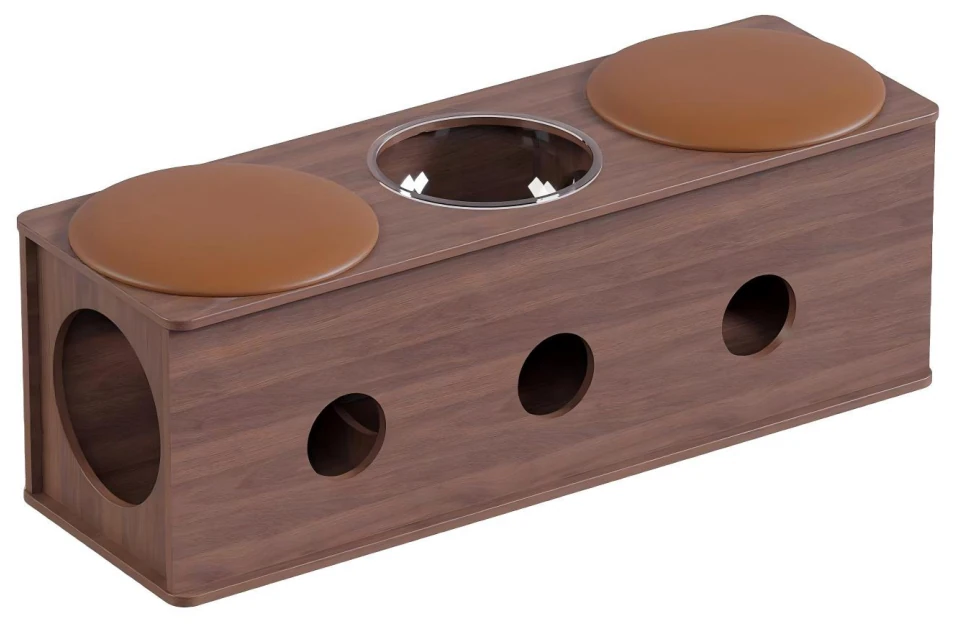
1. Fix the intended bench use
The catalogue describes a bench for placing against a wall, beside a table, as dining seating or for changing shoes. Choose the principal use for your range and ask for the appropriate use limits. The published exterior is 1200 × 400 × 450 mm; it does not establish a seating capacity or maximum supported weight.
Board construction is documented, but its exact core is unknown. The listed colours are walnut, oak, cream white, mist blue, ginger yellow and sage green; confirm the supplied combination and included components. A wood-colour name does not prove solid timber. Give the sample review one clear intended use.
2. Receive the sample before judging the assembly
Ask for the expected number of cartons, panel and hardware schedule, and assembly instruction revision. Photograph carton labels and visible transport damage before opening. Count each supplied item against that schedule, keeping missing components separate from finish or fitting defects. Retain the packaging until the sample record is complete.
Assign a reference to every photograph and bag of hardware. For a damaged capsule or panel, record its position in the carton, adjacent protection and the point in the unpacking sequence when damage became visible. Keep three columns in the receiving sheet: expected item, observed item and action owner. This makes it possible to investigate a packing problem without confusing it with a later assembly error.
3. Approve the human seating surface separately
Follow the supplied assembly sequence on a suitable level surface. Record the useful seat dimensions, fixing locations, accessible edges and any movement. Confirm which parts the supplier intends to support a seated person and obtain the stated use limits. The resting capsule and tunnel panels need their own review; they should not be treated as interchangeable seating surfaces. Stop and request clarification if a fixing cannot be matched to the drawing.
Agree measurable tolerances and an appropriate assessment method before testing. A staff member sitting briefly on the sample cannot establish a published load rating or long-term durability. Request relevant evidence for the intended seating use and have a suitably qualified person advise on any testing beyond ordinary assembly inspection. Record an unresolved limit as an open question, rather than choosing a convenient figure for the retail page.
4. Measure the passage and inspect the capsule
Front openings lead into an enclosed passage, with a scratching pad at the back. Request opening sizes, internal clearance, capsule material and attachment details. Compare those measurements with your intended product description; exterior dimensions alone cannot support a cat-size recommendation.
Demonstrate the intended cleaning route using a documented method. Record which corners can be reached, which parts need removal and how reassembly is explained. Inspect accessible edges and the capsule fixing against the instructions. For a replacement pad or capsule, ask for its identifier, attachment method and order availability. Catalogue presence does not prove that a part is removable, interchangeable or stocked for future service.
- Seat record: useful dimensions, fixing references, observed movement and supported-use evidence.
- Passage record: each opening, minimum internal clearance and demonstrated cleaning route.
- Capsule record: material still to confirm, attachment drawing, received fixings and service questions.
5. Worked example: accept two areas, hold one
Hypothetical example: a UK retailer receives one shoe-changing bench sample. Its panel and hardware counts match the agreed list, and the assembled seat matches the buyer's approved dimensional tolerance. The passage can be reached with the intended cleaning tool, but the capsule fixing does not match the instruction drawing.
The buyer records receiving and passage checks as accepted while placing the capsule on hold. A corrected drawing or replacement fixing must be reviewed before the complete sample is approved. The sample is not displayed for public use while that question remains unresolved. This example describes a buying decision, not a completed product test.
6. Specify Great Britain or Northern Ireland
GOV.UK advises businesses to maintain technical documentation and provide appropriate labelling and safe-use instructions. It distinguishes the product-safety arrangements in Great Britain and Northern Ireland. Specify your actual sales destination and ask the importer or adviser to establish the relevant requirements for the bench.
Keep that review separate from the buying team’s observations. A tidy receiving sheet is useful evidence of what arrived, but it does not certify seating performance or determine every applicable standard. Assign responsibility for the final instruction file, exact-model evidence and customer incident contact. If the sample instruction changes after inspection, check the affected assembly steps again before the approved file reaches the warehouse.
7. Turn acceptance into a warehouse handover
Keep a signed record with three outcomes: human seat, cat passage and capsule. For each, show the observation, photograph reference, decision and unresolved action. Record the assembly time actually observed, tools used and steps needing clarification; one person’s result is not a universal assembly-time promise. Ask another staff member to follow the same approved instruction so unclear steps are found before a wholesale delivery requires repeated support.
Send the approved record to the people receiving the first wholesale order. Recheck colour, capsule and hardware against it, and review substitutions before release. NAVORIQ can discuss a model-specific sourcing enquiry once you provide company type, destination and estimated quantities; commercial terms remain to be confirmed.
Three-part sample checklist
- Fix NAV-F018 / M1018, selected colour combination, intended use and instruction revision.
- Reconcile cartons, panels, capsule and hardware; photograph the unpacking sequence.
- Approve seat dimensions and fixings separately, with intended-use limits still evidenced.
- Measure the passage and review capsule attachment, cleaning access and replacement questions.
- Sign separate outcomes and complete the destination-specific technical-file handover.
Questions before approving a UK bench sample
Can I approve the whole bench from the seat inspection?
No. Record the seat, passage and capsule separately so unresolved fixing or access issues remain visible.
Is a 1200 mm bench automatically a two-person seat?
No seat count is documented. Confirm useful seating space and supported-use limits for the selected version.
Are cushions or extra accessories included?
An image is not an inclusion list. Ask for the written sample and order component schedule.
Product descriptions follow the current NAVORIQ catalogue record. They are not independent test results. Confirm the exact version, evidence and commercial terms before ordering. NAV-F018 / M1018 — product details in English
Official sources and further reading
- GOV.UK — product safety advice for businesses
Official business guidance; confirm the actual sales destination and applicable requirements.
Prepare your UK bench acceptance brief
Send company type, destination, NAV-F018 / M1018, estimated quantities and your three-part sample checklist. NAVORIQ replies in English or Chinese.