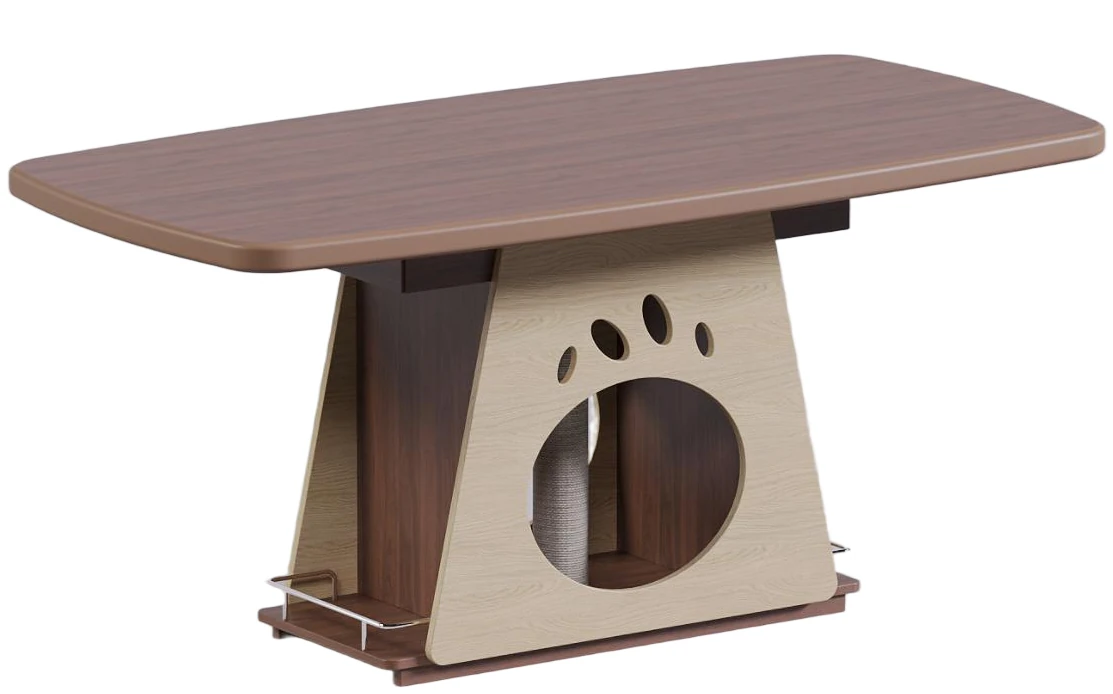
1. Start with the design that is documented
The published dimensions are 1600 × 850 × 750 mm. Round openings provide access beneath the tabletop; scratching material covers part of the support, and stainless-steel side rails help retain bowls or small items. The finish combines oak and walnut tones. These descriptions establish a product brief, but do not establish a seat count, tabletop load limit or animal-size recommendation.
The catalogue describes board construction without identifying the exact core. Treat oak and walnut as finish descriptions until composition is confirmed. Neither a photograph nor a colour name supports a solid-wood claim.
2. Map components before requesting certificates
Give the tabletop, supporting panels, scratching surface and rails separate rows in a document register. Each row needs a component identifier, proposed composition, supplier confirmation date, document reference and unresolved question. Ask whether different panels use different cores or surface treatments. Keep a photograph beside each row so a supplier can identify the actual component, rather than replying about a similarly named table.
For each board component, request the core, thickness, surface layer and edge treatment in writing. Separate a supplier composition statement from a laboratory report or certification document: they answer different questions. Record the issuer and covered material for every attachment. A pallet document does not identify the tabletop core, and a generic panel certificate needs a clear connection to the materials proposed for this order.
- Tabletop: core and surface description; matching document reference; material review open until linked.
- Supporting base: separate panel identities and scratching-surface attachment; compare with the sample.
- Side rails: stainless-steel description, supplied fixings and instruction revision; inclusion and fitting review.
3. Use EPA guidance to frame the missing questions
EPA guidance identifies regulated composite-wood categories including hardwood plywood, MDF and particleboard, and explains finished-goods records and labelling. The unspecified NAV-F074 core prevents a model-specific determination here. Ask the US importer to review the confirmed construction against the current guidance linked below.
Make the review actionable: send the component register with the supplied evidence and ask which gaps prevent release. Record the answer against a particular version and intended shipment. A document bearing an impressive logo is not enough if its holder, material or covered product cannot be connected to the proposed supply chain. Keep that connection available to the person approving the purchase.
4. Give every retail claim an evidence owner
Maintain a second register for proposed listing claims. Mark each statement as approved, awaiting evidence or rejected, and name the person who can release it. Dimensions and visible features can be compared with the agreed sample; emission, sustainability or strength statements require suitable evidence. Avoid replacing an unknown core with a familiar material simply to complete a marketplace field.
Create three listing fields: confirmed description, evidence reference and release owner. For example, “oak-and-walnut contrasting finish” can follow the catalogue; “solid oak tabletop” remains blocked without composition evidence. For the cat feature, describe a passage rather than promising that every cat will fit. Ask for opening and internal-space measurements, cleaning access and scratching-surface maintenance details before writing suitability advice.
5. Worked example: two evidence gaps, one sample decision
Hypothetical example: a retailer evaluates one sample for a future table range. The buyer measures the exterior, photographs the oak-and-walnut finish and compares every supplied component with the packing list. The document register still lacks a confirmed tabletop core, while the sample has an unexplained rail fixing.
The buyer records these as separate hold points. Appearance may be provisionally accepted, but the material claim and fixing approval stay open. The supplier must provide a matching composition statement and an assembly explanation; any required compliance review remains with the importer. This is a proposed workflow, not a NAVORIQ test result.
6. Agree sample acceptance in writing
Before dispatch, agree dimensional tolerances and the viewing conditions for finish approval. At receipt, measure the assembled exterior and photograph panel edges, openings, rail locations and every included fixing. Compare hardware counts and fixing positions with the instruction revision. Use a level reference surface to record rocking or uneven contact, and identify the relevant component instead of reporting only “unstable”. Do not alter the construction to hide a discrepancy.
Do not improvise a loading test from an assumed capacity. Obtain intended-use limits and appropriate test evidence, then agree which checks the buyer can safely perform and which require qualified assessment.
7. Keep the evidence usable for reorders
Save the approved sample identifier, component register, document versions and final listing copy together. A change of board, adhesive, surface layer, rail fixing or material supplier should trigger review before a reorder is released. Ask for written notice of substitutions. Keep the old and new references so the receiving team can distinguish an approved change from an unexplained difference in a repeat order.
For a wholesale enquiry, give NAVORIQ your company type, US destination, estimated quantity and intended sales channel. Ask specifically for the missing material and assembly evidence. Sample terms, minimum quantities, packing and delivery arrangements require confirmation for that enquiry.
Material-file approval checklist
- Identify NAV-F074 / M1053, selected finish and sample version on every register.
- Confirm each board core, surface layer and document connection before material approval.
- Record measured dimensions, edges, hardware and rail fixing observations against agreed criteria.
- Release each retail statement only with its evidence reference and a named reviewer.
- Complete importer review and agree substitution approval before the wholesale order.
Questions from US wholesale buyers
Does the oak-and-walnut finish mean solid wood?
No. The current record describes board construction and does not specify the core. Confirm composition before making a material claim.
Does linking EPA guidance certify this table?
No. It provides general context. The exact construction still needs appropriate evidence and importer review.
Can the sample prove a maximum load?
A visual inspection cannot establish a load rating. Request intended-use limits and relevant test evidence before agreeing any loading assessment.
Product descriptions follow the current NAVORIQ catalogue record. They are not independent test results. Confirm the exact version, evidence and commercial terms before ordering. NAV-F074 / M1053 — product details in English
Official sources and further reading
- US EPA — composite wood stakeholder guidance
Official composite-wood guidance; not approval of NAV-F074.
Request the evidence for your US table brief
Send your company type, NAV-F074 / M1053, estimated quantities and destination with the component questions you need resolved. NAVORIQ replies in English or Chinese.